Gabriel Travel
Gabriel Travel
Gabriel Travel
Prague is celebrated worldwide for its Gothic, Baroque, Art Nouveau, and Cubist architecture — but the city has another, less discussed architectural chapter that is increasingly drawing visitors from around the world. But Brutalist architecture in Prague tells the story of the communist era with a boldness and ambition that its designers intended to be permanent. As local Prague architecture tour guides, these are the Brutalist buildings we consider most worth seeing — and the stories behind them that make them genuinely fascinating rather than merely controversial.
Our private Prague Modern Architecture tour covers Functionalism and Brutalism alongside the city’s Gothic and Baroque heritage — showing how Prague’s architectural story spans not just medieval centuries but the full sweep of the 20th century.
Brutalism may not be the style you instantly associate with Prague, but it is very much part of the city’s heritage. Look up as you explore — the details will surprise you.
The word “Brutalism” comes from the French béton brut (raw concrete), popularized by architect Le Corbusier. There’s no strict definition, but generally Brutalism is recognized by its bold geometric forms — massive, angular, repetitive, and stripped of ornament.
Some see it as harsh, others as beautifully honest. Today, these buildings are increasingly preserved as part of Prague’s unique architectural heritage. Many locals even speak of “Czech Brutalism.”

🌐 Website | Instagram | Facebook
📍 Tower Park, Mahlerovy sady 1, Prague 3
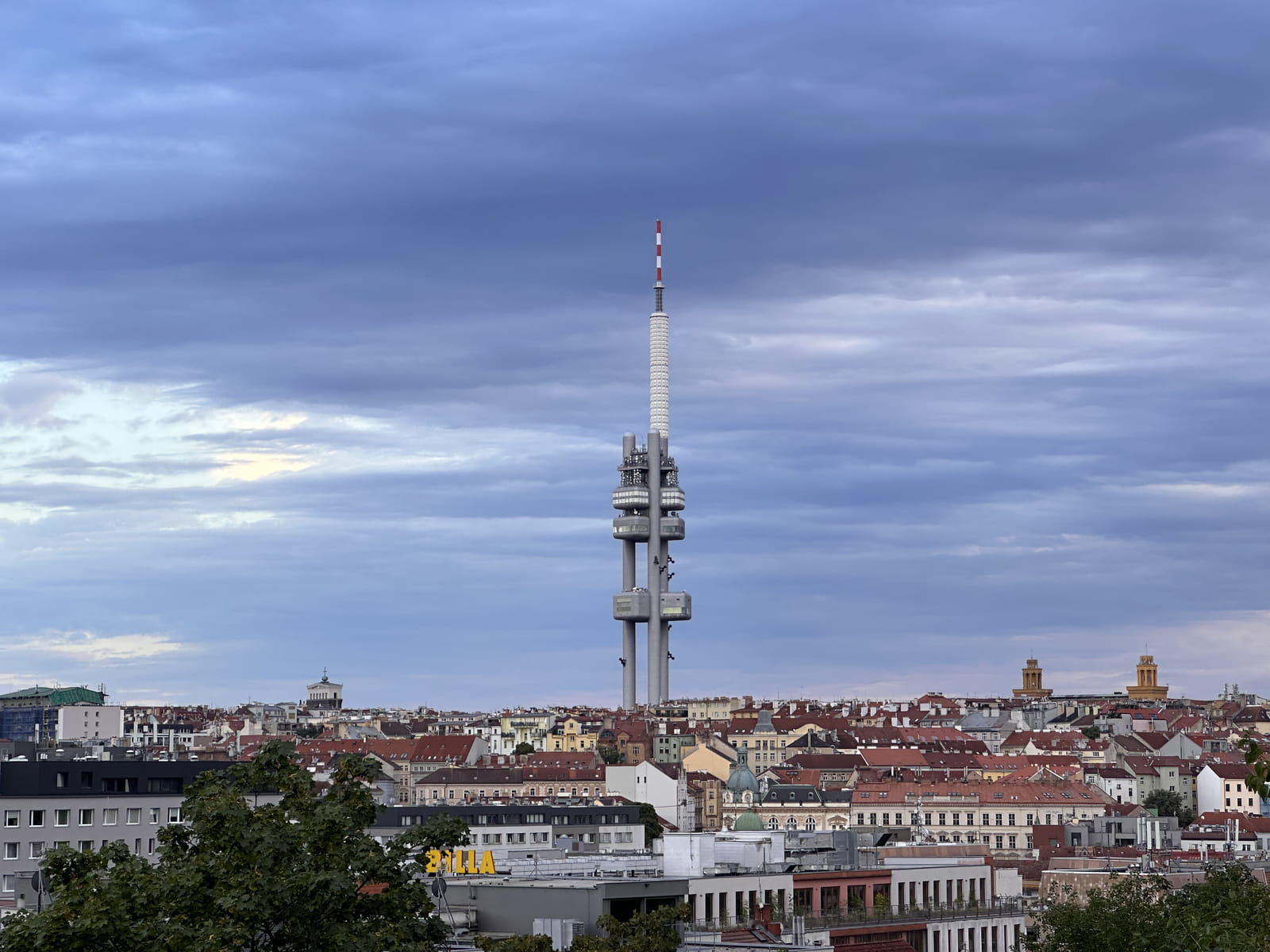
Prague’s tallest structure (216 meters) divides opinion — is it ugly or iconic? Built between 1985 and 1992 by Václav Aulický, the tower resembles a rocket ready for takeoff. Once criticized, it is now embraced as a modern symbol of the city.
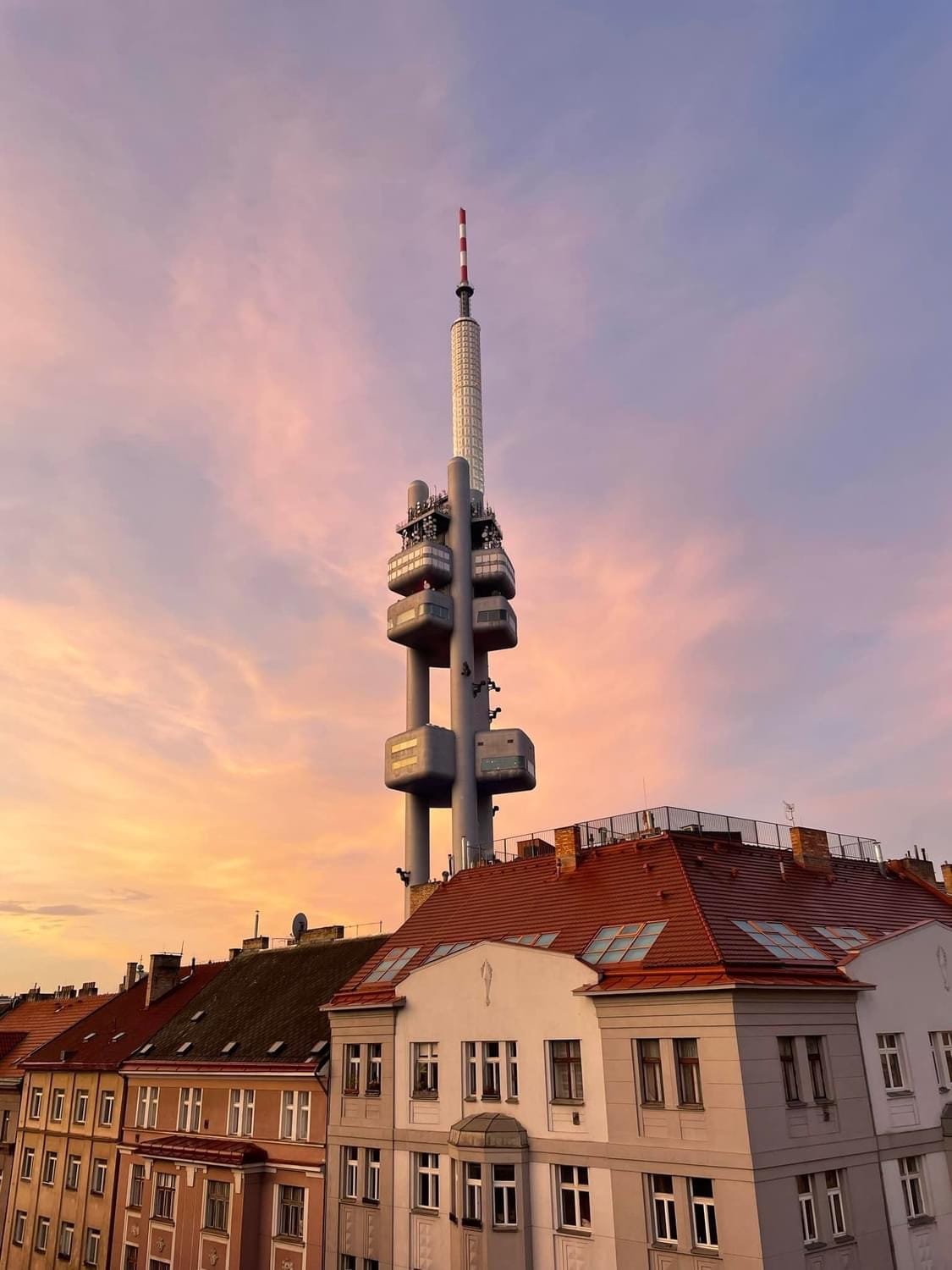
The Žižkov Tower neighbourhood is one of our favourite recommendations for visitors who want to experience authentic Prague beyond the tourist center — the surrounding streets, bars and local atmosphere are genuinely distinctive and increasingly popular with young Praguers.
What to do: Visit the café at 66 meters, the observation deck at 93 meters, or book a night at the unique – One Room Hotel inside the tower.
For families: There’s mini-golf and a small ice rink at its base.
🌐 Website | Instagram
📍 Vinohradská 1, Prague 2
Perched at the top of Wenceslas Square, this bold 1973 structure was originally built for the Federal Assembly. Supported by four massive pillars, it’s a true Brutalist masterpiece by architect Karel Prager.
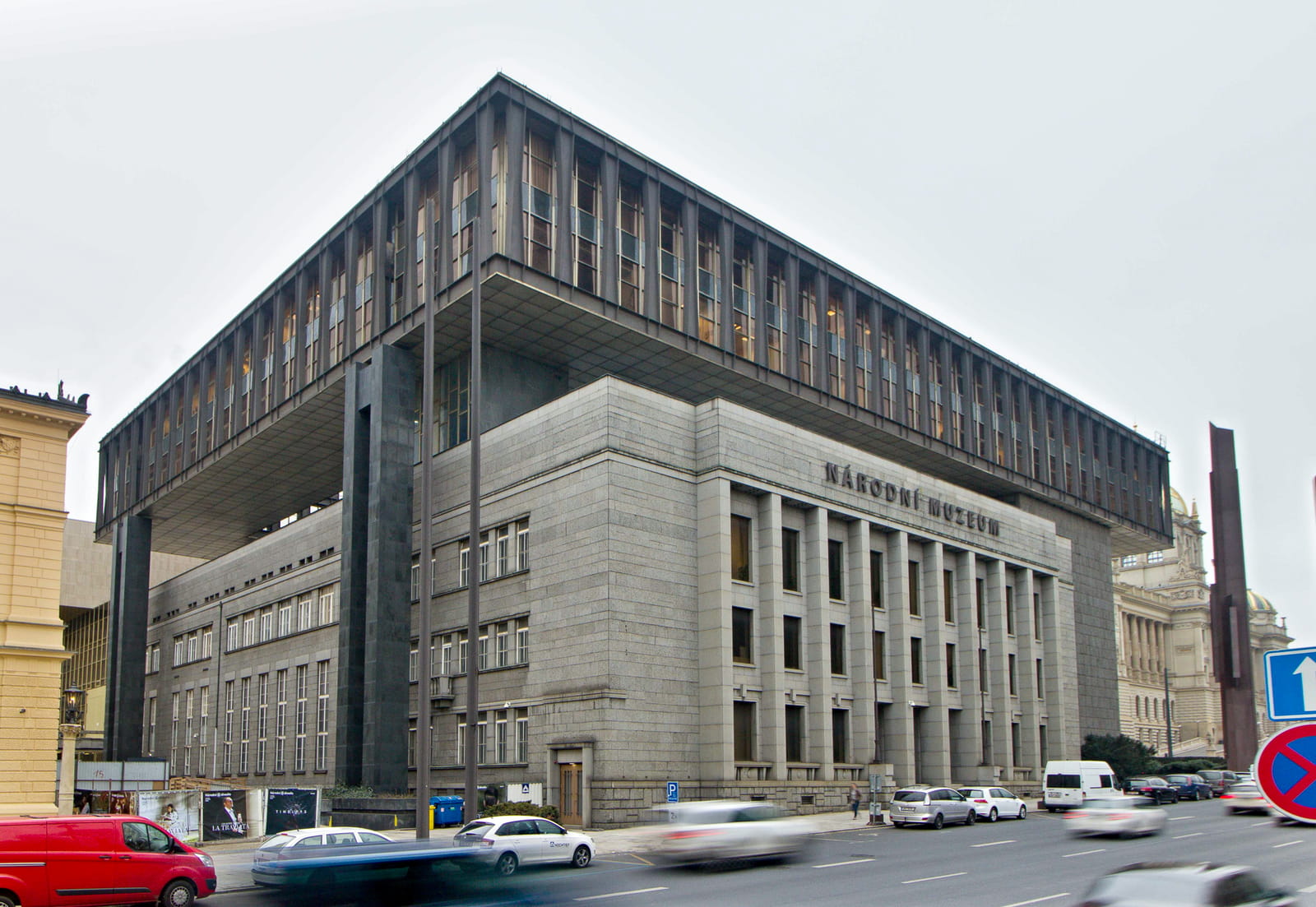
Nearby: The Cold War–era Jalta Hotel still hides a nuclear bunker open for visits.
🌐 Website | Instagram | Wikipedia
📌 Closed for renovation until 2027
📍 Náměstí Republiky 8, Prague 1
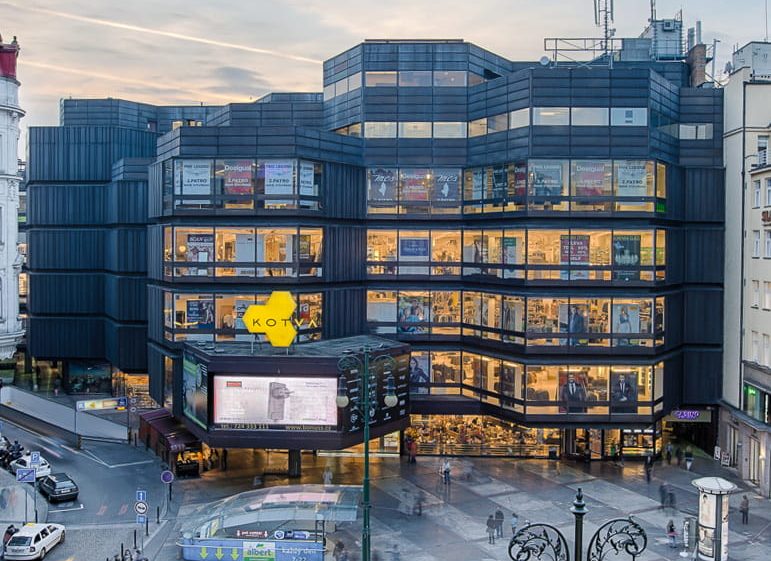
Built between 1970 and 1975, Kotva (“anchor”) was once the pride of socialist Czechoslovakia. Designed by Věra and Vladimír Machonin, its honeycomb-like floorplan of 28 hexagons is an architectural curiosity. At its peak, it was among Europe’s five largest shopping centers.

Though it declined in the 1990s, Kotva is now recognized as a cultural monument, with renovations ensuring its Brutalist legacy remains intact.
🌐 Website | Instagram | Facebook
📍 Náměstí Curieových 5, Prague 1
One of Prague’s most strategically located Brutalist buildings — the Fairmont Golden Prague Hotel, originally known as the Hotel Intercontinental — sits in the Jewish Quarter on the Vltava riverbank. Built in 1974, its angular concrete facade creates a striking contrast with the Art Nouveau buildings of Pařížská Street behind it.
The rooftop terrace and upper floor views toward Charles Bridge and Prague Castle are extraordinary. The hotel’s Czechoslovak communist-era story — built specifically to house Western business travellers during the Cold War — adds a fascinating layer of political history to what might otherwise seem like simply a large concrete hotel.
🌐 Website | More Info
📍 Národní 63, Prague 1
Máj department store was built by architects Miroslav Masák, John Eisler, and Martin Rajniš in 1975 — this is considered one of the finest examples of Czech late modernism blending Brutalist principles with retail functionality. The building’s glass and concrete grid facade became so iconic that it was purchased by Tesco in the 1990s.
🌐 Website | More Info
📌 Closed for renovation until 2028
📍 Národní 4, Prague 1
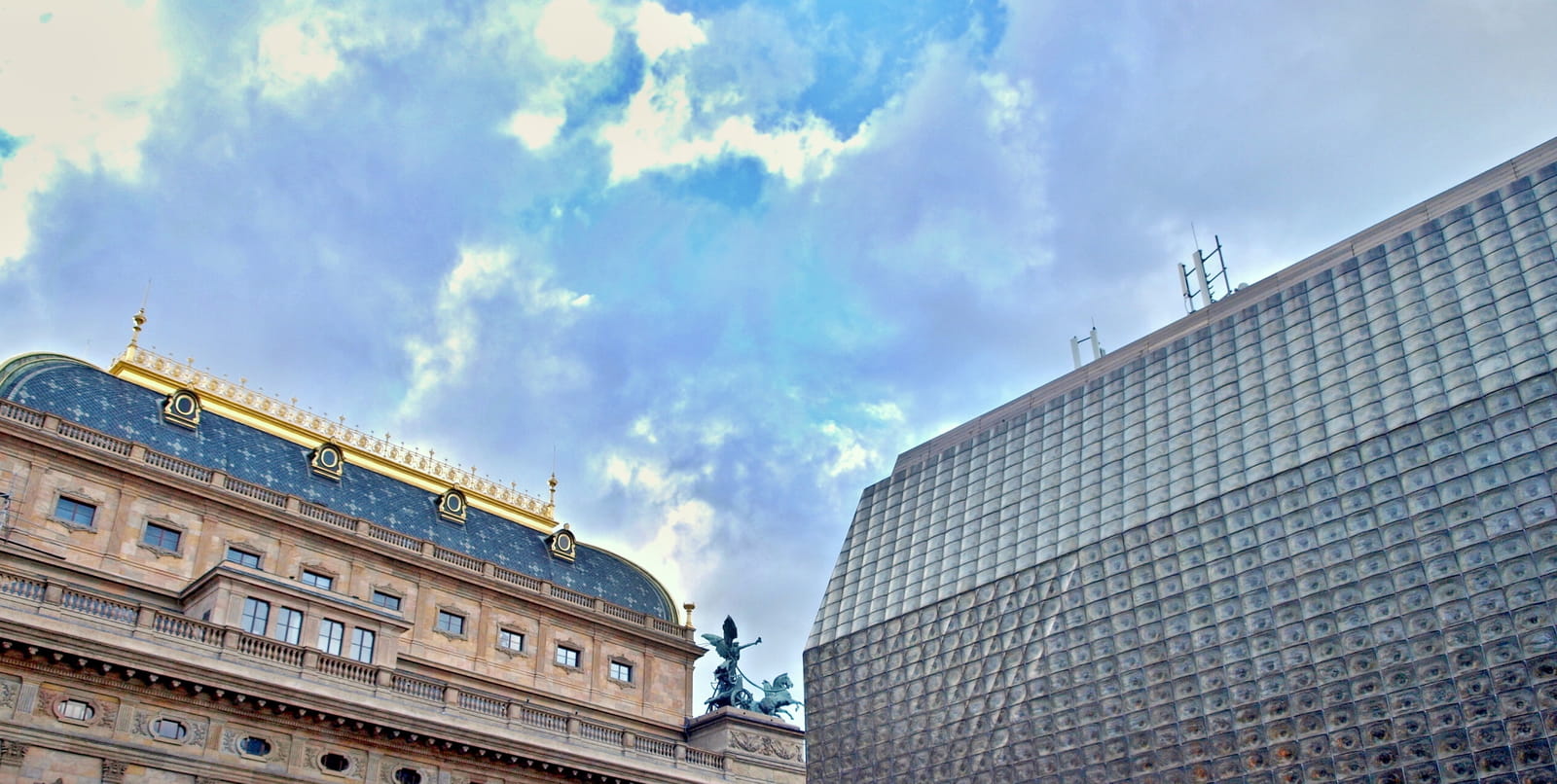
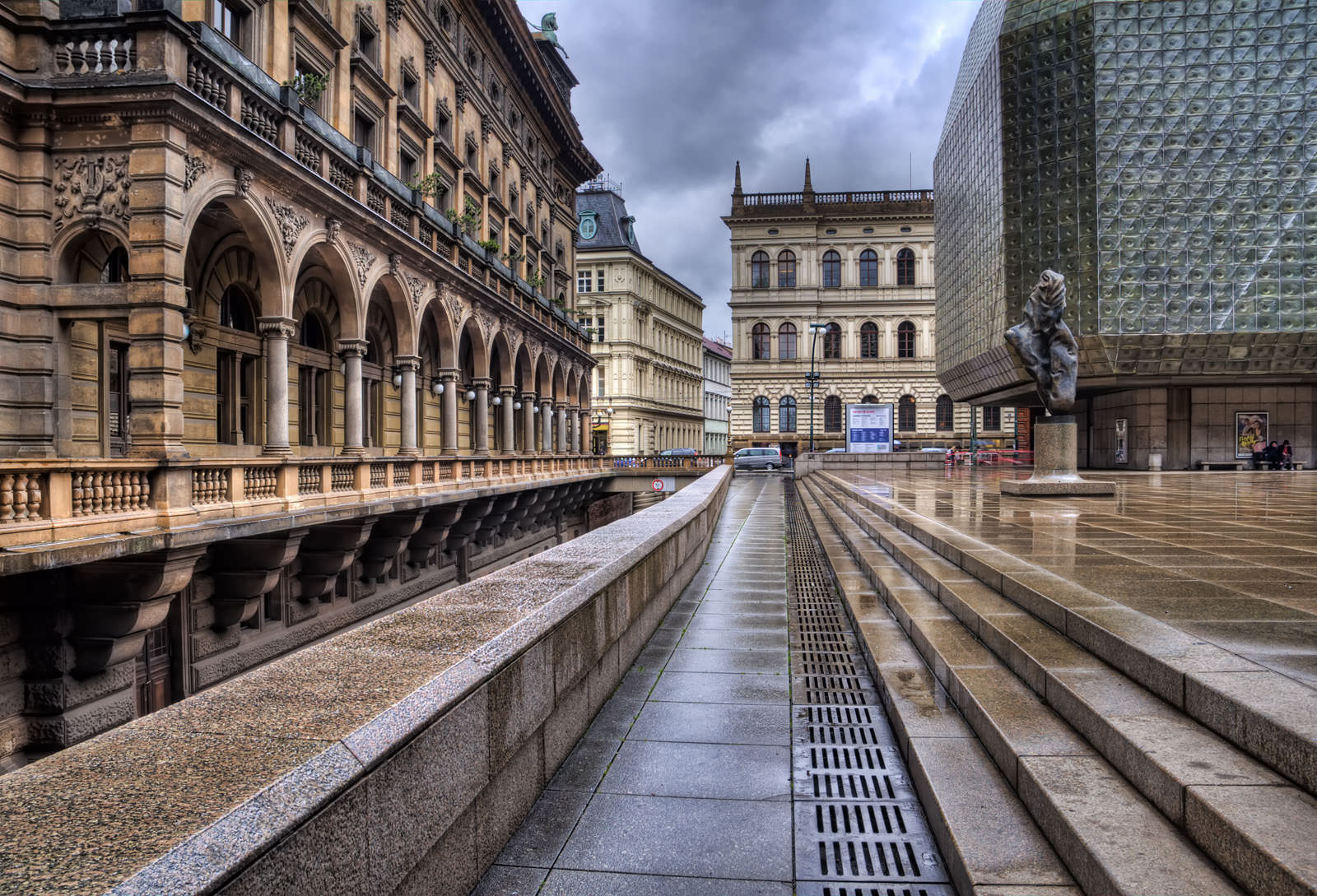
A striking contrast to Prague’s Neo-Renaissance National Theatre, this crystal-like Brutalist building opened in 1983. Its façade features over 4,000 glass blocks, complemented by interiors of marble and crystal.
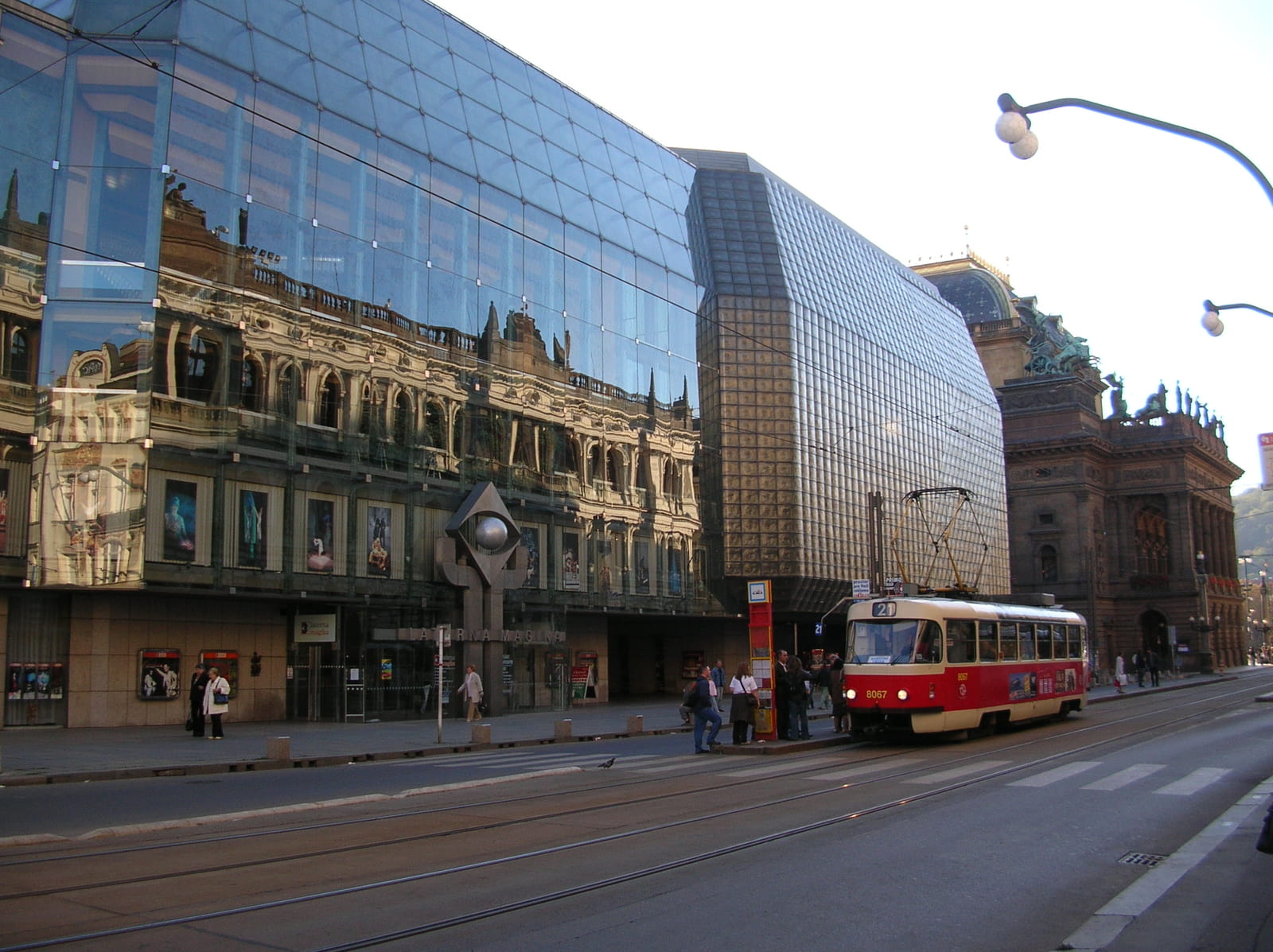
Tip: Look for the nearby Václav Havel Square, Václav Havel Square, with its symbolic red heart.
Stay in a Brutalist Hotel For a truly unique Prague experience, why not spend a night in a Brutalist-style hotel? One Room Hotel (inside the Žižkov Tower) – the most unusual stay in Prague.
Orea Hotel Pyramida – a 1987 pyramid-shaped hotel once meant to impress foreign visitors.
Mama Shelter – a stylishly renovated 1960s hotel blending Brutalist roots with modern design.
While Gothic cathedrals and Baroque palaces may steal the spotlight, Prague’s Brutalist buildings tell the story of a different era — the Communist period of the 1960s to 1980s. These structures are bold, raw, and sometimes controversial, but they are undeniably part of the city’s identity.
Whether you love them or find them challenging, exploring Prague’s Brutalism offers a fascinating, offbeat perspective on the city — one that goes far beyond the postcard-perfect views.
Prague’s Brutalist buildings offer photography opportunities that most visitors completely miss — the geometric forms, concrete textures and dramatic scale create images unlike anything in the more photographed historic center.
Best photography spots:
Žižkov Tower from Vítkov Hill — the tower photographed against the city skyline with the Jan Žižka statue in the foreground creates a powerful composition that contrasts ancient and modern Prague dramatically.
Federal Assembly from Wenceslas Square — the building’s four massive pillars and the open ground floor create strong geometric compositions particularly effective in black and white.
New Stage next to the National Theatre — the contrast between the neo-Renaissance theatre and its glass block Brutalist neighbour is one of Prague’s most deliberately dramatic architectural juxtapositions.
Kotva exterior during renovation — the scaffolding and covered facade actually create interesting layered compositions showing the building in transition.
Our Prague photography tours can include Brutalist architecture specifically — the buildings photograph particularly well in overcast light when the concrete textures become most defined.
The Academy Award-winning film The Brutalist (2025) brought unprecedented attention to Brutalist architecture worldwide — and to Prague specifically. Adrien Brody, who won Best Actor for the film, has spoken about his fascination with Prague’s raw concrete architecture developed during his many years filming in the city.
The film itself tells the story of a Hungarian Jewish architect who arrives in post-war America — a story that resonates deeply with Prague’s own architectural history. The communist era buildings in Prague were constructed by architects working under ideological constraints not entirely unlike those facing the film’s protagonist.
If The Brutalist brought you to Prague’s architecture — these are the buildings to seek out. And if you want to understand the human stories behind them, our private architecture tours provide the political and cultural context that transforms concrete buildings into compelling history.
Fascinated by Prague’s architectural evolution — from Gothic to Baroque to Art Nouveau to Brutalism?
Our private Prague architecture tours cover the full spectrum — from medieval to modernist — with expert local guides who know the stories behind every significant building in the city.