Gabriel Travel
Gabriel Travel
Gabriel Travel

© Draceane, CC BY-SA 4.0, via Wikimedia Commons
At one point or another during your stay in Prague, you will probably pass near Petřín Hill. It rises to the left of the Castle. We strongly recommend climbing it. Once at the top, the panorama is unique. This hill holds many surprises across its 78 hectares, including a very pleasant funicular that will take you to the summit effortlessly. With this article, you won’t miss anything this hill has to offer.


Formerly a pilgrimage site, laid out as gardens and vineyards as early as the 12th century, Petřín Hill—named from the Latin *petra*, meaning rock—was opened to the public at the beginning of the 19th century. You can’t miss it, with the metallic summit of its tower rising above the treetops. Today, it is a pleasant green park, perfect for walking, with its network of winding paths. Růžová zahrada, Zahrada Nebozízek, Seminářská zahrada, Lobkovická zahrada or Strahovská zahrada:
Lovers kiss here on May 1st, and throughout the rest of the year, Czechs stroll, picnic, go sledding… You can enjoy absolute peace and a fantastic view of the Castle and Prague’s tiled rooftops. We recommend walking along the northern part of the park — Vrtbovská zahrada, where you’ll spot the U.S. Embassy and, a bit further on, the beautiful gardens of the German Embassy. But above all, we advise you — when you are at the Nebozízek restaurant — located in the heart of the park, where the funicular stops — to head toward the Hunger Wall, which will be on your right as you face the river. Along these few meters, you’ll have the chance to take magnificent photos of the Castle or the city. These will probably be your most beautiful shots of Prague—believe us!


If you’re already tired from sightseeing, opt for the funicular, which children will also enjoy Eiffel Tower + mirror maze here. The current funicular dates from 1985 and is the third one in service since 1891. On July 25, 1891, the Petřín funicular was put into service, powered by water. Operations ended in 1916 during World War I and resumed only in 1932, when the funicular was rebuilt with electric propulsion. It then served the public reliably for more than 30 years. In 1965, major landslides occurred on Petřín Hill, destroying the funicular track. After a twenty-year interruption, the Petřín funicular resumed service in 1985, when it was integrated into the public transport system.
The funicular carries more than 2 million passengers every year (56.5 million people since 1985) and has been part of Prague’s public transport for nearly 130 years. The departure station is at Újezd, in the Malá Strana district. The funicular goes all the way to the top of the hill, with a stop at the Nebozízek restaurant and its lovely panorama. Another dining option is a bit further north: Petřínské terasy. The ride lasts only four short minutes! Once at the top, you’ll find an astronomical observatory, a lovely rose garden, and above all, the viewpoint on your right.
Every day, 9:00 am–11:20 pm (every 10–15 minutes)
Price: 60 CZK (about €2.40) or long-term passes (24 hours and more)
More information over here:

Although the hill rises to 327 meters, you must also add the 58.7 meters of the miniature Eiffel Tower that crowns it. Commissioned by the Czech Tourist Club for the Jubilee Exhibition of 1891, the tower was built two years after the Eiffel Tower, at a scale of 1:5. Climb its 299 steps or take the elevator—an impressive panoramic view of Prague awaits you! On a clear day, your gaze stretches across all of Bohemia. You can buy a combined ticket with the mirror maze mentioned just below here:
Every day: 10:00 am–6:00 pm
(7:00 pm in April, May, and December;
8:00 pm from June to September)


Right next to the viewpoint stand the Baroque Church of Saint Lawrence (built on Romanesque remains between 1735 and 1770), as well as the pavilion of the Czech Tourist Club from the 1891 Exhibition. Originally located at the Exhibition Grounds, the pavilion was later moved here. It is a miniature of the medieval Špička Gate, which was part of the Vyšehrad fortifications. Inside the pavilion, you can also see a panoramic painting depicting the defense of Prague against the Swedes. It mainly delights both children and adults with its maze and distorting mirrors, where you can take fun photos.
Another unusual spot in the middle of the park that has always amazed us is the magical cave of the artist Reon Argondian. You’ll find it by walking downhill from Nebozízek (the intermediate funicular station) toward Újezd (the tram stop at the bottom).
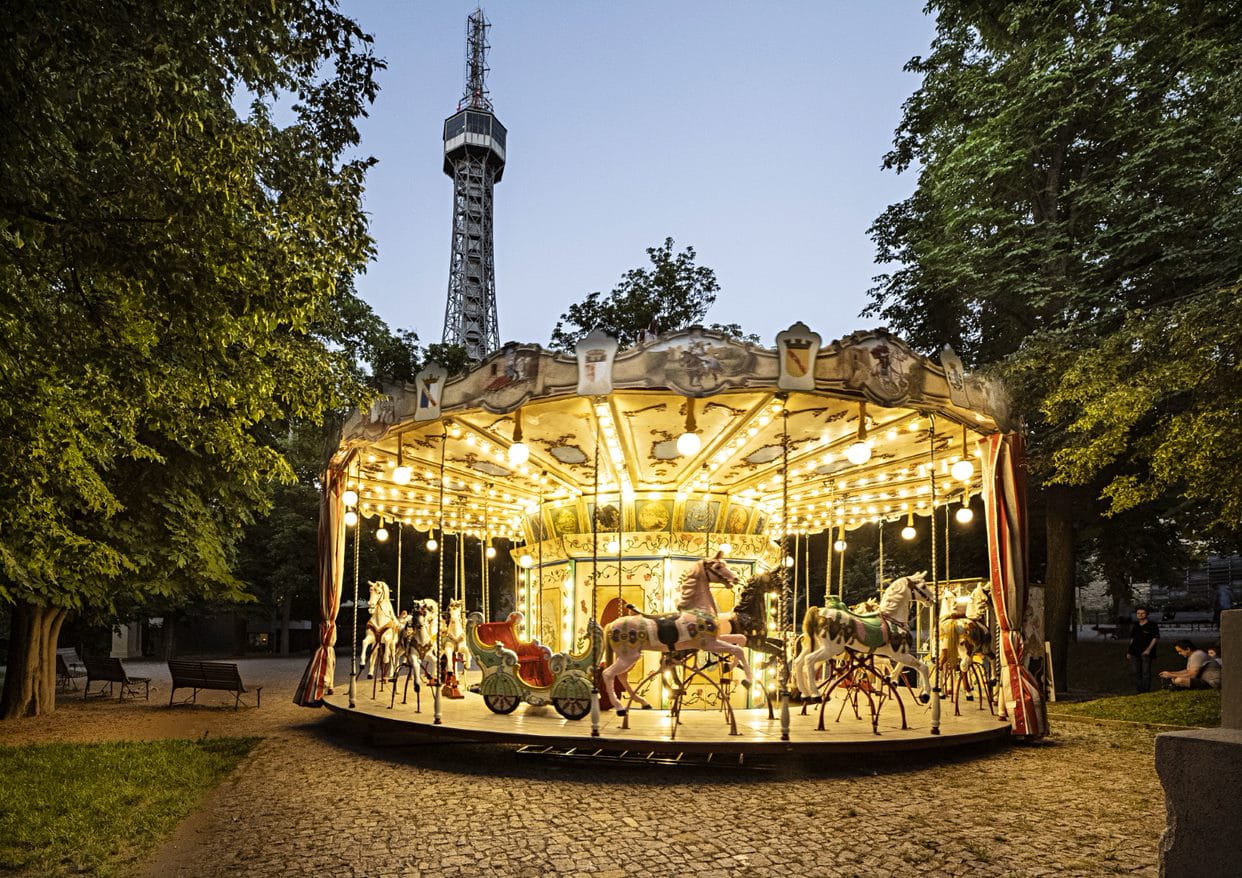
A 200-year-old carousel from Florence also spins near the observation tower. You can enjoy it every day from June to September (9:00 am–9:00 pm, 100 CZK or about €4 per ride), riding in one of the hand-carved wooden carriages or horses! Adults who have kept a childlike spirit are welcome too.


All Czechs know the poem *Máj* (May), written by Karel Hynek Mácha (1810–1836). Every May 1st, Prague residents come to lay lilac flowers and kiss in front of the statue of the great Romantic poet. You’ll find this statue by following the wall of the old fortifications (ask locals—they’ll know the way). If you prefer to be more discreet, tradition also holds that couples kiss under one of the many blossoming cherry trees. Beware: superstition says that any girl who is not kissed on May 1st will wither within twelve months…

Built under Charles IV between 1360 and 1362, this wall provided work and food for many residents suffering from drought and famine. It is also called the Hunger Wall because of its crenellations, which resemble the jaws of the poor. These are former city fortifications of Prague, and you’ll see them in many places during your walk on Petřín—the funicular even passes through them. The Hunger Wall separates Petřín Hill from the Kinský and Strahov gardens to the north and from the Smíchov district to the south. The Kinský Gardens are also worth discovering: the Empire-style Kinský Villa, the Carpathian Church of St. Michael, and lovely ponds.

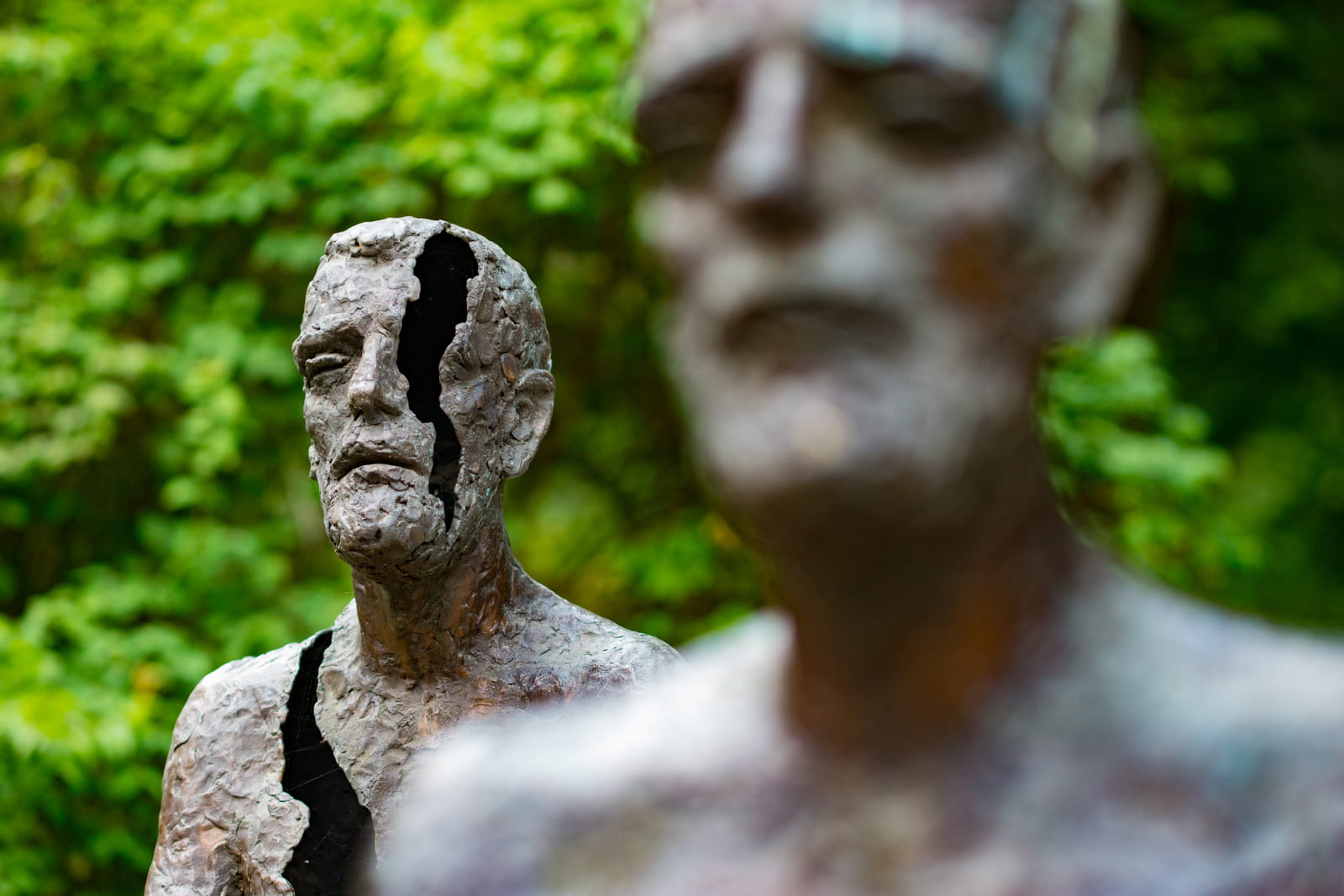
At the extension of Vítězná Street, which you may have walked down if your tram came from the opposite riverbank—strange figures descend a staircase. This is the Memorial to the Victims of Communism. Installed in 2002, these seven bronze statues by Olbram Zoubek, more or less damaged, symbolize all victims of totalitarianism, whether arrested, exiled, imprisoned, killed, or executed.
Get off at the Újezd tram stop (trams 7, 9, 12, 20, 22, and 23), climb the few steps leading into the park, and turn right. The funicular station is right over there.
When leaving, if you head west, after a few hundred meters you’ll reach Strahov Stadium, the largest stadium in the world. It once hosted the Spartakiads—mass sports events of the communist regime—and in 1995, the Rolling Stones played there in front of 127,000 spectators and President Havel. If instead you head northwest, you’ll arrive at the Strahov Monastery.